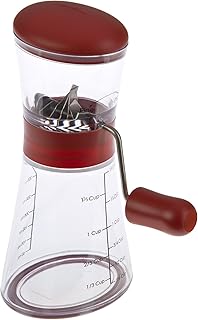
Choppers come as press-down tools with cutting grids, hand-operated bowls with rotating blades, and powered bowls. Grids produce pieces shaped by their openings, while rotating blades chop progressively finer as you work the mechanism or pulse the motor. Start with the capacity your usual batch needs.
Judge usable capacity against your usual ingredients, not the container’s appearance in a photograph. Whole onions and bulky leaves take up space differently, and some choppers need food cut into sections before loading. For rotating-blade models, check the recommended fill level so ingredients have room to circulate. A large bowl may leave a small portion beneath or away from the cutting path, while an undersized container means repeated loading and emptying for a large recipe. For a grid chopper, compare the cutting opening with the vegetables you intend to load: a generous collecting container does not mean a large potato will fit through the cutter.
Permitted ingredients should narrow the choice before convenience features do. For nuts, hard spices or raw meat, look for explicit permission in the manual; the chopper name alone tells you little about suitability. Then match the operating mechanism to your hands and ingredients: dense vegetables can require substantial force through a grid, while a pull cord requires a secure grip and repeated pulling. A powered bowl reduces manual cutting effort, but check whether its operating and cooling instructions accommodate your usual batch preparation. With rotating-blade choppers, use short pulls or pulses for tomatoes and other juicy ingredients to limit overprocessing.
Before buying, allow clearance above the chopper for its lid, plunger or handle to open fully. A Plastic entry in the material filter does not identify what the blade or hinge is made from; find those parts specified separately. For cleanup, confirm which components are dishwasher-safe and how trapped food is removed from grid corners and blade assemblies. For grid models, check which cutting grids and cleaning tools are included and which are sold separately. For either mechanism, check whether replacement blades or cutters are available.
How we list products: every listing here has a recorded price, a minimum customer rating and enough ratings or monthly sales. Generic and unbranded listings are left out; every real brand stays, including brands sold only on Amazon. Products are ordered by the same ProductDome score on every page.Editorial policy

 Best Overall