
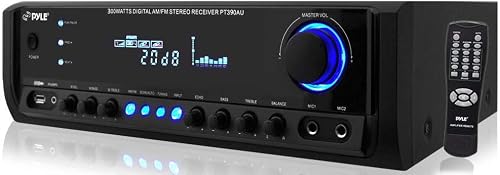
Pyle PT390AU 4-Channel Home Audio Amplifier
- 300 watts peak power, drives 4 to 16 ohm speakers
- 4 speaker channels, 4 pairs of terminal posts
- 2 microphone inputs with echo, bass, and treble control
- 7 total input sources, including usb and am/fm tuner
- 50 AM/FM station presets stored in memory
- 2 lb, digital lcd display and wired remote included
Last refreshed Aug 4, 2026 · Based on the Amazon listing and published specifications, not hands-on testing.
A budget four channel amplifier built for karaoke nights or a small pa setup, with dedicated mic inputs and tone control, though the remote cannot power the unit on or off.
As an Amazon Associate I earn from qualifying purchases. ProductDome earns a commission when you buy through links on this page.
ASIN: B00BQ5RULUModel: PT390AUCategory: AV Receivers
Overview
Connect a microphone, phone, or usb drive to this amplifier and it routes the signal to up to four paired speakers for a karaoke session or small gathering. Rotary knobs handle equalization and microphone effects like echo, while a digital display shows the active source. An am/fm tuner and antenna round out the built in options.
This amplifier suits someone hosting karaoke or small events who wants two mic inputs with echo control alongside a phone or usb audio source. Its manual push button power switch means the included remote adjusts volume and sources but cannot turn the unit on or off. There is no hdmi output, so it stays limited to speaker level audio rather than a home theater setup.
Who it's for
Someone running karaoke nights, small pa announcements, or a basic home audio setup gets two mic inputs with echo and tone shaping plus a phone or usb source option. A shopper wanting full remote control including power, or hdmi video switching, will find this amplifier limited on both counts.
Pros and cons
- Two microphone inputs include echo and tone control
- Rotary eq knob adjusts sound without menus
- Drives four pairs of speakers from one amplifier
- AM/FM tuner stores station presets automatically
- Remote cannot power the unit on or off
- No HDMI output for video sources
- USB port limited to smaller flash drives formatted fat32
Performance notes
The amplifier splits its output across four speaker terminal pairs, so total power divides among however many speakers are connected at once. Mic inputs run through dedicated bass, treble, and echo circuits before reaching the master output, separate from the main source volume. The usb input reads audio files directly from a connected drive rather than streaming over a network.
Specifications
| Brand | Pyle |
|---|---|
| Model | PT390AU |
| Dimensions & fit | |
| Weight | 2 poundslower than 90% of 43 av receivers |
| Dimensions | 18.2 × 14.7 × 7 inches |
| Power & efficiency | |
| Power | 300 wattshigher than 72% of 40 av receivers |
| Construction & materials | |
| Color | Black |
| Compatibility & installation | |
| Connectivity | USB |
| Other details | |
| Brand Tech | Pyle |
| Channels | 2 |
Closest rivals on specs
 Onkyo TX-NR6100 7.2-Channel AV Receiver
- Power 300 vs 210 watts (+43%)
- Weight 2 vs 10.4 pounds (-81%)
 Onkyo TX-NR5100 7.2-Channel 8K Smart AV Receiver
- Power 300 vs 80 watts (+275%)
- Weight 2 vs 8.4 pounds (-76%)
 Marantz NR1510 Slimline 5.2 Channel AV Receiver
- Power 300 vs 50 watts (+500%)
- Weight 2 vs 8.16 pounds (-75%)
Frequently asked questions
Can the Pyle PT390AU connect to a television over HDMI?
No, it has no HDMI port; connect the television's RCA audio output instead, since the amplifier only accepts RCA, USB, and aux sources.
What size USB drive works with the PT390AU?
It supports smaller drives formatted to FAT32 with mp3 files placed in the main directory, rather than very large modern usb drives.
Does the PT390AU output surround sound?
No, it is a stereo to multi channel speaker amplifier without dedicated surround processing or a subwoofer output channel.
What is included in the box with the Pyle PT390AU?
It ships with the amplifier, an am/fm antenna, an audio cable, and a remote control that operates volume and input selection.