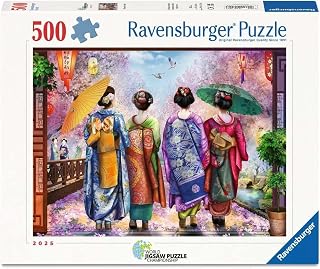
Jigsaw puzzles range from scenes with distinct objects and clear colour boundaries to images dominated by repeated patterns or broad areas of similar colour. Start with the artwork: recognisable sections give you landmarks to build around, while skies and repeated textures call for closer comparison between similar-looking pieces. For shared puzzling, separate detailed areas give participants sections they can tackle independently. Then compare the finished dimensions with your table or puzzle board, allowing additional space for loose pieces and sorting. Rectangular and Square describe the outline but cannot tell you whether that working area is sufficient.
Among the 7 products that list manufacturer recommended age, most fall between 13 and 15 years, and 14 years is typical. For children taking part, read the manufacturer’s age guidance alongside the small-parts warnings, including when younger children could reach pieces left out during assembly.
Inspect close-up pictures of the cut to assess how much individual piece shapes vary, especially if you enjoy using contours as clues when colours look alike. If picking up or turning small pieces is difficult, use stated piece dimensions or photographs showing their scale to judge handling; the finished puzzle’s dimensions do not tell you how large each piece is. Decide how much picture guidance you want, too. Some puzzles provide a complete reference, while others partly reveal the finished scene or supply an image that differs from it. For surprise-image or clue-based formats, read the description of how the reference and any instructions support assembly before choosing the extra uncertainty.
Before buying, look beyond the Cardboard and Chipboard labels for details of piece thickness, edge finish and interlocking construction, which those labels leave unspecified. If glare makes printed details difficult to distinguish, look for a description of the printed surface’s finish. A reference poster, sorting trays or storage mat may be supplied or sold separately, so establish what the box contains. If you plan to move an unfinished puzzle, confirm that the chosen board or mat accommodates its finished dimensions. Finally, read the seller’s missing-piece procedure, including whether help means an individual replacement piece or replacement of the puzzle.
How we list products: every listing here has a recorded price, a minimum customer rating and enough ratings or monthly sales. Generic and unbranded listings are left out; every real brand stays, including brands sold only on Amazon. Products are ordered by the same ProductDome score on every page.Editorial policy

 Best Overall