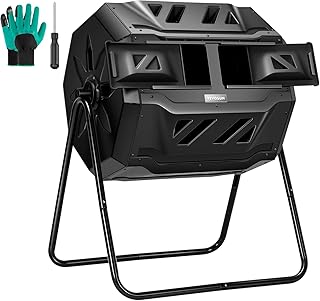
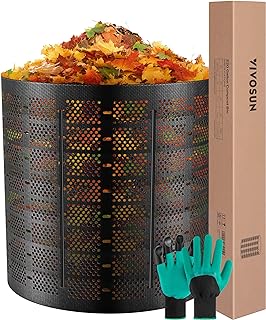
Composting bins come as open frames or mesh enclosures and as enclosed containers with lids: the former give broad access for bulky garden waste, while the latter keep the pile behind walls and a cover. Unlike Composting Tumblers, stationary bins do not rotate to mix their contents, so access for a fork or compost aerator matters if you plan to turn the pile. Start by deciding how much material you need to accommodate between adding waste and removing finished compost.
Size the bin around your regular kitchen scraps and garden waste, including seasonal surges such as fallen leaves. Among the 19 products that list capacity, most fall between 19 and 128 gallons, and 50 gallons is typical.. Leave room for dry leaves or other suitable brown material alongside fresh additions; filling the bin with grass clippings leaves little space to balance the mixture. Advertised capacity describes holding volume, not how quickly that volume becomes usable compost. Breakdown depends on the ingredients, moisture, aeration and weather. If you keep adding fresh waste, allowing space for a separate batch to mature can be more useful than putting everything into a larger undivided bin.
Access, ventilation and closure design affect how easily you can manage that load. A broad loading opening helps when emptying a garden cart, while a low removal hatch needs enough clearance to draw out compost with your shovel. Adjustable vents give you a way to change airflow, but exposed mesh can let a pile dry faster in windy conditions. Where animals are a concern, look for a securely fastened lid and protected openings; a lid alone leaves other entry routes, particularly around an open base.
Before buying, confirm whether the bin requires direct contact with soil or permits installation on paving, and measure the assembled footprint against the intended spot. The manual should identify accepted ingredients, especially if you intend to add food scraps beyond fruit and vegetable peelings. Material descriptions such as Plastic or Polypropylene (PP) do not tell you how the panels join, so inspect the fastening and assembly details. Establish whether any required ground fixings or rodent barrier are supplied or sold separately, and whether replacement lids, hatch doors and panel clips are available.
How we list products: every listing here has a recorded price, a minimum customer rating and enough ratings or monthly sales. Generic and unbranded listings are left out; every real brand stays, including brands sold only on Amazon. Products are ordered by monthly searches for their brand and model on every page.Editorial policy


 Best Overall