A rugged hard cooler built around thick foam walls, rubber latches and a hinge designed not to break. The listing gives no empty weight and no ice retention figure.
A practical 16-can soft cooler for day use, built to solve the zipper problem and keep food from getting crushed, though its stated ice retention tops out around two days.
A durable, well-insulated daily lunch cooler that clips onto a Carhartt backpack, with reviewers confirming both the fit and the cold-hold with a standard ice pack.
A tough, heavily insulated hard cooler for camping, fishing and boat trips. It is heavy before any ice goes in, so short carries and vehicle loading suit it more than long walks.
A dual-purpose water cooler and handwashing station that holds up well for team sports and camping, with a lid that can leak when overfilled and a spigot that eventually needs a cheap replacement.
A capable hard cooler built for general outdoor and party use with a hose-compatible drain and child safety latch, though you should confirm the exact capacity on the specific listing before buying.
A basic personal-size hard cooler for single-person use, worth considering mainly for its small footprint and one-handed carry rather than long ice retention.
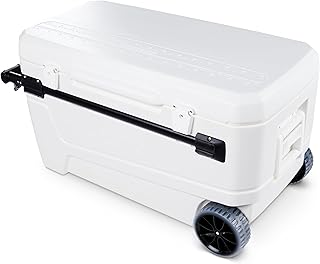
A large, wheeled hard cooler built for hauling drinks and food over sand or gravel on multi-day trips, with ice life that runs shorter than the 5-day claim in hot weather.
A large, wheeled hard cooler built for hauling drinks and food over sand or gravel on multi-day trips, with ice life that runs shorter than the 5-day claim in hot weather.
For a sideline or jobsite where cans and ice do not matter, this half-gallon insulated jug delivers quick access to cold water through a flip-cap spout.
A large capacity wheeled cooler that earns its bulk on group camping or fishing trips where you need to roll a fully loaded box, though it is more than most day trips call for.
A tiny personal cooler for a lunch or a couple of drinks, in a limited edition print. Insulation type and exterior size are missing from the listing, so cold holding is hard to judge.
These 10 camping coolers have the highest ProductDome scores among the established products in this category, meaning ones with a large volume of owner ratings and strong evidence; on a tie, the product with more rating evidence ranks first. The score combines owner satisfaction, rating volume, demand and data quality from public Amazon listings (updated 3 days ago). We do not test products ourselves.
Igloo, Coleman, Rtic, Yeti, RTIC lead this category among the 24 brands that passed our curation checks.
How does ProductDome pick these camping coolers?
A listing appears only when it has a recorded price, a minimum customer rating, and enough ratings or monthly sales. Generic and unbranded listings are left out, while every real brand stays, including brands sold only on Amazon. The ones that pass are ordered by the ProductDome score, which weighs owner satisfaction, rating volume, demand and data quality.
About camping coolers
Camping coolers include rigid chests and soft-sided carriers, some of which compress for storage when empty. Start with how much food and drink you need between resupply stops, including the space required for ice or cold packs; that sets the capacity to look for before choosing a carrying arrangement.
Among the 24 products that list capacity, most fall between 4.9 and 62 quarts, and 21 quarts is typical. Compare advertised packing examples with your intended mix of meal containers, drinks and cooling supplies, since a can count may assume a different amount of ice than you need. Check usable internal height against your tallest bottles and the opening against your widest food tub, leaving room to retrieve items without unpacking the cooler.
For trips between ice stops, assess advertised ice retention against the stated conditions: starting temperature, ice quantity, outdoor heat and frequent opening can change performance. Where those conditions are missing, the claimed duration gives little basis for planning when to replenish ice. Use a cooler thermometer to monitor storage temperatures for perishable food; an ice-retention claim does not tell you whether the food stays adequately cold. Check the opening instructions and product photos for closures that require two hands or straps that must be moved before opening. Carrying arrangements should suit the route from vehicle to campsite: assess the cooler’s empty weight together with your expected contents before relying on a shoulder strap. For wheeled designs, compare wheel size and tread with the ground you expect to cross, particularly sand, roots or gravel.
Before buying, compare exterior dimensions and lid clearance with the vehicle space where you intend to store and open the cooler. For Water Resistant or Waterproof claims, verify the conditions covered and whether they apply to the closure; rain protection does not necessarily mean the cooler contains meltwater when tipped. Plastic and Polyester labels may refer to different components, so identify the exterior and the food compartment lining separately. The manual should explain how to clean the lining and closures, empty meltwater and dry seams before storage. If you need a basket to keep food above melting ice, confirm that it fits the cooler and whether it is supplied or sold separately.
How we list products: every listing here has a recorded price, a minimum customer rating and enough ratings or monthly sales. Generic and unbranded listings are left out; every real brand stays, including brands sold only on Amazon. Products are ordered by the same ProductDome score on every page.Editorial policy
Cookie settings
We use necessary cookies to keep the site working. Page views are counted without cookies. With your permission, we also use functional and marketing cookies. Cookie Policy.

 Best Overall