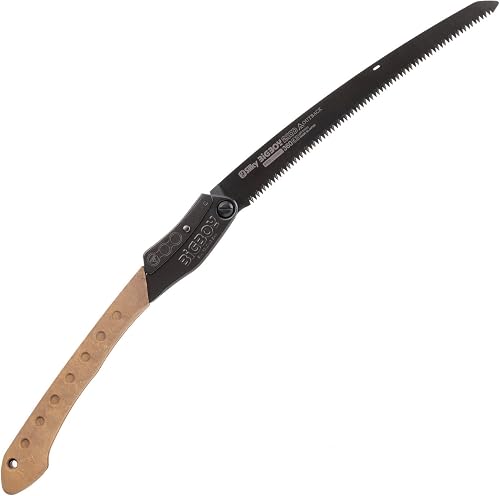
Folding saws tuck the blade into the handle so the saw can ride safely in a pocket, a pack or a vehicle, and they are the go to tool for pruning, trail clearing, camping and cutting firewood. They differ from bow saws, which cut faster through thick logs but are bulky, and from Japanese pull saws for joinery. The first decision is the thickness of branches you cut most, because a short blade is compact but slow on thick limbs, while a longer blade cuts faster but takes more space.
Blade length and teeth are the next questions. Among the 5 products that list blade length, most fall between 6.7 and 12 inches, and 6.7 inches is typical. Most folding saws cut on the pull stroke with aggressive, hardened teeth that cut green wood quickly; coarse teeth suit pruning and logs, while finer teeth leave a cleaner cut on dry wood and small branches. Curved blades pull themselves into the cut and suit overhead pruning, while straight blades are easier to control on the ground.
Lock and handle matter for safety and comfort. A blade that locks in both the open and closed positions stops it folding onto your fingers mid cut, and a rubberised handle with a hand guard gives a secure grip with gloves or wet hands. Replaceable blades are worth having, since hardened teeth are difficult to resharpen.
Before buying, check the blade length, tooth count, lock mechanism, overall length when folded, the weight, and whether replacement blades are sold. Cut with smooth strokes and let the teeth do the work, keep your free hand well away from the blade line, and fold the saw closed whenever you move. Wipe sap off the blade after use to keep it cutting freely.
How we list products: every listing here has a recorded price, a minimum customer rating and enough ratings or monthly sales. Generic and unbranded listings are left out; every real brand stays, including brands sold only on Amazon. Products are ordered by the same ProductDome score on every page.Editorial policy

 Popular Pick