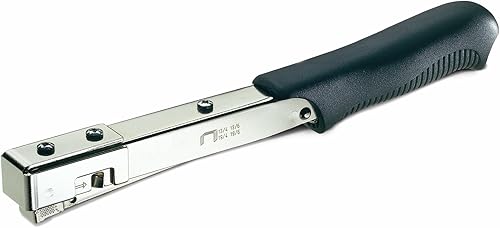
Hammer tackers range from compact tools for lighter fastening to larger designs that accept longer staples, but the permitted staple sizes vary by model. Unlike squeeze-operated staple guns, they drive a staple with a swinging strike, making them suited to repeated fastening across open surfaces; a staple gun is easier to position precisely beside an edge or obstruction. First decide whether your work leaves enough room to swing and strike squarely, especially between framing members or near corners.
For work with adequate swing clearance, weight is the next practical choice because you lift and reposition the tool throughout the job. Among the 5 products that list item weight, most fall between 0.9 and 2.9 pounds, and 1 pounds is typical.. A lighter tacker is easier to carry between fastening locations and raise repeatedly when working above waist height. Compare the listed weight with a hand tool you comfortably handle for a similar stretch of work, and confirm whether that weight describes the tacker itself or a packaged kit. Weight alone cannot tell you which staples the tool accepts or whether it suits the surface you intend to fasten into.
Match staple compatibility to both the covering and the underlying surface. The staple must pass through the covering and obtain sufficient purchase in a substrate the tacker is intended to fasten into, so use the manual’s guidance for your particular combination of materials. Longer staples are not automatically suitable for thinner coverings, and a hammer tacker should not be assumed to fasten into masonry or metal. For felt, paper or other tear-prone sheets, look for a striking face designed to spread contact around the fastening point. Magazine capacity also matters on uninterrupted runs: compare the stated staple load when frequent reloading would interrupt your working position.
Before buying, confirm the exact staple series, crown width and permitted leg lengths; similar-looking staples may not feed correctly. Establish whether a starter supply is included or must be bought separately. The loading instructions should show how the magazine opens and whether the follower remains attached, while the jam-clearing procedure should explain whether additional tools are needed. A material filter marked Alloy Steel or Blend leaves the component unclear, so inspect the description for what the housing, magazine and striking face are made from. For ongoing repairs, check whether the driver and magazine spring are replaceable and whether those parts are available separately.
How we list products: every listing here has a recorded price, a minimum customer rating and enough ratings or monthly sales. Generic and unbranded listings are left out; every real brand stays, including brands sold only on Amazon. Products are ordered by the same ProductDome score on every page.Editorial policy

 Popular Pick