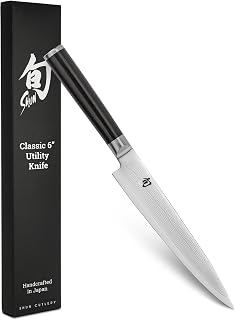
A precise mid-size knife for trimming vegetables and slicing meat and cheese, with a lifetime warranty and free sharpening. The thin, hard edge rewards careful use and hand washing more than rough board work.
Wüsthof Classic Ikon Serrated Utility Knife 5 Inch
A short forged serrated knife that slices firm foods without crushing them. Serrations are slower to resharpen and the short blade will not handle big loaves or roasts.
A forged in-between knife for sandwiches, cheese, pickles and apples, with a grippy Santoprene handle. It must be hand washed, and the warranty term is stated two ways.
A sensible serrated utility knife for tomatoes, citrus and small bread jobs, with a soft grip that stays secure. It is hand wash only, so it cannot join the rest of the dishwasher load.
A handcrafted Japanese utility knife with a hard steel core and a finish that helps food release. As a single mid-length blade, it complements a chef's knife instead of replacing one.
A forged in-between knife for fruit, small vegetables and detail cuts, balanced toward the handle for control. Hand washing is recommended, and the straight edge is no help on crusty bread.
These 4 kitchen utility knives have the highest ProductDome scores among the established products in this category, meaning ones with a large volume of owner ratings and strong evidence; on a tie, the product with more rating evidence ranks first. The score combines owner satisfaction, rating volume, demand and data quality from public Amazon listings (updated 3 days ago). We do not test products ourselves.
What are the most popular kitchen utility knives brands?
Shun, Wüsthof, Henckels, Zwilling, Wusthof lead this category among the 24 brands that passed our curation checks.
How does ProductDome pick these kitchen utility knives?
A listing appears only when it has a recorded price, a minimum customer rating, and enough ratings or monthly sales. Generic and unbranded listings are left out, while every real brand stays, including brands sold only on Amazon. The ones that pass are ordered by the ProductDome score, which weighs owner satisfaction, rating volume, demand and data quality.
About kitchen utility knives
Kitchen utility knives fill the gap between a paring knife and a chef’s knife for everyday jobs such as trimming fruit and cutting sandwiches, with shorter and longer blades offering different amounts of reach. Start with blade length for the ingredients you regularly prepare: trimming strawberries and halving a sandwich put different demands on the cutting edge. If slicing full loaves is the main job, look at bread knives, whose longer blades give you more room for a sawing stroke across a broad crust.
Judge blade length against the width of your usual ingredients, not the knife’s overall length, which includes the handle. Among the 31 products that list bladelength, most fall between 5 and 6.5 inches, and 6 inches is typical. A blade that barely spans a sandwich leaves little edge available for the cutting stroke; a longer blade can feel cumbersome when guiding the tip around a small piece of fruit. Product photographs can distort proportions, so use the stated blade measurement when assessing reach.
Next, look at the blade profile and how you hold the knife. For chopping on a board, inspect the clearance beneath the handle when the edge touches the board; a shallow blade may leave your knuckles in the way. A curved cutting edge accommodates a rocking stroke, while a straighter section suits cuts made by lifting and lowering the blade. Handle contours matter separately: pronounced finger grooves may crowd your grip, so look for dimensions and photographs showing where your fingers would sit, especially if you grip near the blade.
Before buying, read the intended-use guidance for restrictions on bones, frozen food or twisting the blade through resistant ingredients. A blade-material label such as High carbon stainless steel is not a substitute for the maker’s washing and drying instructions; consult care guidance for the handle as well. Read the maker’s sharpening instructions for the specific knife, then confirm that your sharpener supports its edge type and specified sharpening angle. If the knife will go in a drawer, check whether a fitted blade guard is supplied or sold separately.
How we list products: every listing here has a recorded price, a minimum customer rating and enough ratings or monthly sales. Generic and unbranded listings are left out; every real brand stays, including brands sold only on Amazon. Products are ordered by the same ProductDome score on every page.Editorial policy
Cookie settings
We use necessary cookies to keep the site working. Page views are counted without cookies. With your permission, we also use functional and marketing cookies. Cookie Policy.

 Best Overall