As an Amazon Associate I earn from qualifying purchases. ProductDome earns a commission when you buy through links on this page.
Best Overall
Knife Sharpeners
OXO Good Grips Non-Slip Knife Sharpener
A compact pull-through sharpener that brings dull straight kitchen knives back with a few strokes, then smooths the edge. It does not handle serrated blades, and no sharpening angle is listed.
A walnut kitchen knife sharpener made in Germany and sold as an easy sharpening kit. The listing details leave out the abrasive type, grit and sharpening angle, so confirm those against your knives first.
Victorinox Swiss Classic Fibrox Honing Steel 10 Inch
Model: 6.8002.US1
A dependable way to keep kitchen knife edges aligned between sharpenings, with a comfortable textured grip. It realigns rather than removes metal, so a truly dull blade still needs a sharpener.
Victorinox Swiss Classic Fibrox Honing Steel 10 Inch
Model: 6.8002.US1
A dependable way to keep kitchen knife edges aligned between sharpenings, with a comfortable textured grip. It realigns rather than removes metal, so a truly dull blade still needs a sharpener.
Work Sharp Professional Precision Adjust Knife Sharpener Kit
A guided system for owners who want repeatable edges across kitchen, pocket and hunting knives, with a wide run of abrasives. It is a bench setup, so it asks for more time than a pull-through sharpener.
Spyderco Tri-Angle Sharpmaker Knife Sharpening System
A fixed angle ceramic sharpener that gives repeatable edges on straight and serrated knives with simple vertical strokes. Only two angle settings are offered.
A versatile powered sharpener for anyone with a mix of kitchen knives, pocket knives and tools, with repeatable angles and speed control. The belts are a consumable, and the box contents are not spelled out.
A guided fixed-angle sharpener that reviewers rate as delivering genuinely sharp, consistent edges, with a small amount of flex in the knife mount as its main mechanical shortcoming.
A strong match for anyone who wants repeatable angles from coarse repair through polish on many knife sizes. It is a bench system with a case, so each session takes more setup time than a quick touch-up tool.
A two-sided honing steel with an angle guide matched to Shun's edge angle, for keeping fine knives aligned between sharpenings. It maintains an edge rather than restoring a dull one.
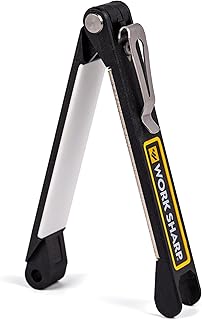
A pocket size two stage sharpener with built in angle guides for touching up knives and tools in the field. It is a maintenance tool, not a full reprofiling system.
Work Sharp Mk.2 Electric Knife Sharpener with Replacement Belts
A belt sharpener that handles kitchen knives, serrated blades and garden tools with a two speed motor. Belt grits, belt count and angle settings are not given in the listing.
ZWILLING Miyabi Ceramic and Diamond Knife Sharpener
A two stage disc sharpener made for hard Japanese steel that handles easy resharpening at home. The listing leaves out the angle, the box contents and serrated blade support.
Lansky TB-2D2C Turn Box Diamond-Ceramic Sharpening System
Model: Turn Box TB-2D2C
A compact, stable rod sharpener for touching up kitchen knives at two set angles. It maintains edges well but is slow for repairing badly damaged blades.
A sturdy bench sharpener that handles everything from machetes to fillet knives at four set angles. It is a V-style tool, not a polishing stone system.
These 9 knife sharpeners are the most searched brands and models among the established products in this category (monthly searches for each brand and model); on a tie, the one with more owner ratings ranks first. Product data comes from public Amazon listings (updated 15 days ago). We do not test products ourselves.
What are the most popular knife sharpeners brands?
Work Sharp, Sharp Pebble, HORL, Lansky, Sharpal lead this category among the 33 brands that passed our curation checks.
How does ProductDome pick these knife sharpeners?
A listing appears only when it has a recorded price, a minimum customer rating, and enough ratings or monthly sales. Generic and unbranded listings are left out, while every real brand stays, including brands sold only on Amazon. The ones that pass are ordered by how many people search for that brand and model each month; review counts only break ties.
About knife sharpeners
Knife sharpeners come as pull-through tools, powered machines, guided abrasive systems and freehand stones. Pull-through tools and many powered machines guide the blade through slots, guided systems mechanically control the sharpening angle, and freehand stones leave that control to your hands. Start by deciding how much technique and setup you want each session: slot guides simplify positioning, clamped systems require securing the blade, and stones require practice holding a consistent angle.
Compare the working motions against the time and handling you are prepared to manage. Pull-through tools require controlled strokes, while powered machines require attention to the manual’s feed speed and pressure. With a guided system, look at how you turn the blade or move the abrasive to sharpen both sides; with stones, expect to maintain the angle as you follow the curve toward the tip. If you carry the sharpener with your knives, its weight also matters. Among the 37 products that list item weight, most fall between 0.1 and 3 pounds, and 0.6 pounds is typical. Compare the listed weight with what you are comfortable carrying, and use dimensions to judge whether it fits your storage space.
Your knives must suit the sharpener’s supported edge angles and blade configurations. Match those specifications to the knife maker’s sharpening guidance, especially for blades sharpened on a single side, since a preset slot can change the existing edge geometry. Serrated edges and ceramic blades require explicit support; scissors need instructions and equipment intended for their edge geometry. Then distinguish routine touch-ups from repairing chips or restoring a severely dulled edge. The grit filter includes Fine and combinations such as Coarse, Fine, but these labels alone cannot tell you whether a sharpener suits that task. Use the manufacturer’s stated purpose for each abrasive or stage to make that choice.
Before buying, confirm clamp capacity, blade-length restrictions and clearance around the handle or bolster so the abrasive can reach the intended cutting edge. The base or mounting instructions should explain how the sharpener stays in position during its working stroke. For stones, establish whether preparation requires soaking, water or oil, and whether a holder is supplied or sold separately. For powered machines, look for instructions on collecting and removing metal debris. Find out whether stones require flattening, what equipment that requires, and whether replacement abrasives, belts or sharpening modules are available and supplied or sold separately.
How we list products: every listing here has a recorded price, a minimum customer rating and enough ratings or monthly sales. Generic and unbranded listings are left out; every real brand stays, including brands sold only on Amazon. Products are ordered by monthly searches for their brand and model on every page.Editorial policy
Cookie settings
We use necessary cookies to keep the site working. Page views are counted without cookies. With your permission, we also use functional and marketing cookies. Cookie Policy.


 Best Overall