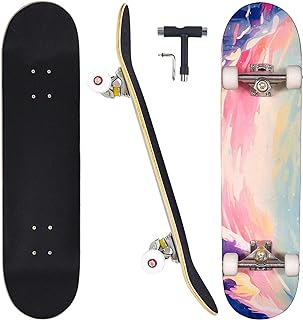
A pre-assembled 32 by 8 inch maple skateboard with a mellow concave, forged trucks and sealed bearings, built for riders learning ollies, flip tricks and street skating.
A ready-to-ride popsicle complete for street and park skating, assembled with named-brand parts. The hard wheels are aimed at smooth concrete, so rough-road cruising is outside its focus.
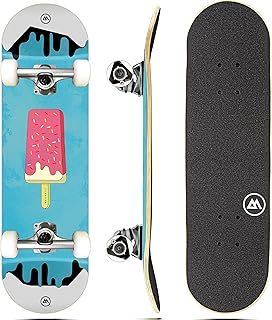
A licensed-graphic beginner skateboard with a 9-ply maple deck and aluminum trucks, ready to ride out of the box for kids learning to cruise and carve.
A low, stable drop-through longboard built for downhill and cruising, with an extra-wide deck and grippy tape to match, despite a mismatched category label on this listing.
These 10 standard skateboards have the highest ProductDome scores among the established products in this category, meaning ones with a large volume of owner ratings and strong evidence; on a tie, the product with more rating evidence ranks first. The score combines owner satisfaction, rating volume, demand and data quality from public Amazon listings (updated 3 days ago). We do not test products ourselves.
What are the most popular standard skateboards brands?
Globe, Retrospec, Santa Cruz, Arbor, Baker lead this category among the 27 brands that passed our curation checks.
How does ProductDome pick these standard skateboards?
A listing appears only when it has a recorded price, a minimum customer rating, and enough ratings or monthly sales. Generic and unbranded listings are left out, while every real brand stays, including brands sold only on Amazon. The ones that pass are ordered by the ProductDome score, which weighs owner satisfaction, rating volume, demand and data quality.
About standard skateboards
Standard skateboards come with decks that curve upward at both ends for tricks, or more directional shapes geared toward cruising; the shape affects how readily you can ride either end forward and lift the nose or tail. If your main aim is sustained cruising, compare with Longboard Skateboards, which generally offer a longer platform but take more space to carry and maneuver. Within standard skateboards, start with deck width to find a platform that suits your stance and intended riding.
Deck width affects the space under your feet and how the board feels when you tip it onto an edge. Among the 5 products that list deck width, most fall between 6.7 and 8 inches, and 8 inches is typical.. A wider deck gives more room to place your feet when landing or riding ramps, while a narrower deck can feel easier to rotate for flip tricks. Shoe size is a useful starting point, but it should not decide the purchase by itself: your preferred stance and the movements you want to learn matter too. If you have a board that feels comfortable, compare its width with the listed deck width.
Wheel hardness and diameter should suit the surfaces you expect to ride. Softer wheels generally cushion rough pavement better, while harder wheels suit smooth skatepark surfaces and slides. Larger wheels roll across small surface irregularities more readily, but need enough clearance beneath the deck to avoid contact during turns. Truck width also matters: compare the axle width with the deck width, since a substantial mismatch can leave wheels protruding or tucked too far underneath. Be careful with truck measurements that describe the hanger instead of the full axle.
Before buying, compare your riding weight, including anything carried, with the manufacturer's stated load limit, and confirm that the board permits your intended use, including tricks if planned. Skill labels such as Beginner and All cannot substitute for those details. Establish whether the purchase is a complete skateboard or a deck requiring separate components; product photographs may show a finished setup. For a complete board, the listing should explain any assembly or adjustment required before riding. For upkeep, consult the manual's cleaning guidance and check whether replacement bearings and bushings in the required sizes are available.
How we list products: every listing here has a recorded price, a minimum customer rating and enough ratings or monthly sales. Generic and unbranded listings are left out; every real brand stays, including brands sold only on Amazon. Products are ordered by the same ProductDome score on every page.Editorial policy
Cookie settings
We use necessary cookies to keep the site working. Page views are counted without cookies. With your permission, we also use functional and marketing cookies. Cookie Policy.

 Best Overall