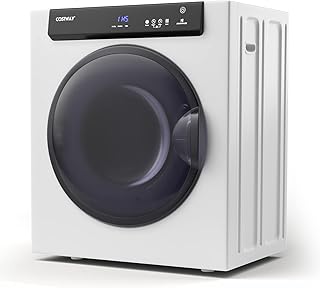
Portable dryers come as compact tumble machines, heated hanging enclosures, and spin dryers: tumble machines turn clothes in a drum, hanging enclosures dry suspended garments with warm air, and spin dryers extract water but leave clothes needing further drying. Establish which result you need before comparing capacity: a spin dryer will not replace a heated dryer when you need clothes ready to put away.
Choose capacity around the portion of your usual wash you need to dry together, allowing extra room for bulky towels or bedding. Among the 6 products that list capacity, most fall between 1.3 and 3 cubic feet, and 2.1 cubic feet is typical. For bulky items such as duvets, check the manufacturer's load guidance to establish whether the dryer can accommodate the specific item you intend to dry. Drum volume and a capacity stated in pounds describe different things, so do not treat them as interchangeable. For weight limits, establish whether the manufacturer means dry laundry weight; for hanging enclosures, look for both the hanging weight limit and room between garments. In heated dryers, clothes need space for movement or airflow, so a load that physically fits may still be too crowded to dry effectively. Advertised drying times depend on test conditions; fabric thickness, load size, and moisture left after washing affect the time your laundry needs.
Heat settings matter if your laundry mixes sturdy cottons with garments whose care labels restrict tumble drying or heat. Match the dryer's permitted fabrics and settings to those labels; a hanging enclosure does not make every delicate garment suitable for heated drying. For heated models, compare timed operation with automatic moisture sensing if you want the machine to stop according to dryness rather than a preset duration. If moving the dryer between uses is part of your routine, compare its stated weight with what you can lift and look for handles or wheels intended for that movement.
Before buying, check voltage and circuit requirements, then compare appliance dimensions plus required clearances with your available space, including room for opening or assembling the dryer. Establish whether the model needs an exhaust route, collects water, or requires a drain, and whether the necessary hose, adapter, or collection container is supplied or sold separately. For tumble models, look for accessible lint filters and, on vented dryers, exhaust connections you can reach for cleaning; for hanging enclosures, assess whether the cover-cleaning requirements are manageable at home. If the dryer uses a proprietary filter or fabric cover, check replacement availability.
How we list products: every listing here has a recorded price, a minimum customer rating and enough ratings or monthly sales. Generic and unbranded listings are left out; every real brand stays, including brands sold only on Amazon. Products are ordered by monthly searches for their brand and model on every page.Editorial policy