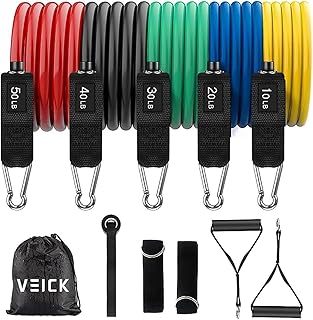
A well-equipped latex band set with real range from light stretching to a genuinely heavy stacked pull, worth choosing over a bare band set for the handles, anchor, and straps included.
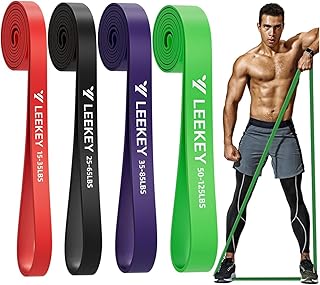
A reasonably specified four-band resistance set with a door anchor for pull-up assistance and general strength work, priced as a starter kit rather than a single premium band.
A durable, portable single band well suited to arm work and anchored exercises, with a noted length limitation for taller users doing leg work and one report of a band failing under standing use.
A straightforward flat-band set with a genuine range of resistance and no latex smell, worth it for rehab or Pilates use where color-coded strength levels matter.
A graduated 5-band fabric set built to stay put during leg and glute work, though the material includes latex and no reviews back the durability claims yet.
At this price the set is a reasonable pick for stretching, warmups and rehab, but expect the rubber to be the weak point if pushed hard at the heaviest resistance level.
This reads as a warmup and activation band rather than a strength-building tool, aimed at hip and shoulder complex work before training rather than as the main resistance source.
A dedicated ankle-cuff band for glute and hip isolation work. Reasonable if that's the specific movement pattern you're training, though no owner reviews back up durability claims yet.
A well-reviewed graduated band set for pull-up training and rehab stretching, though treat the printed resistance numbers as a rough guide rather than an exact figure.
A straightforward 4-level loop band set built around a wider, non-pinching design, a reasonable pick for graduated resistance without full gym equipment.
What are the most popular resistance bands brands?
THERABAND, HPYGN, Tribe Lifting, HOXWC, WIKDAY lead this category among the 28 brands that passed our curation checks.
How does ProductDome pick these resistance bands?
A listing appears only when it has a recorded price, a minimum customer rating, and enough ratings or monthly sales. Generic and unbranded listings are left out, while every real brand stays, including brands sold only on Amazon. The ones that pass are ordered by how many people search for that brand and model each month; review counts only break ties.
About resistance bands
Short loops suit movements with the band around the legs, long loops offer reach for standing exercises and assisted pull-ups, and tubes with handles provide a grip for rows and presses. Flat strips can be held at different points, though the manual should explain permitted grips and attachments. Start with the exercises you intend to perform and whether they need a continuous loop, free ends or handles, since these formats are not interchangeable for every movement.
Band length must suit your starting position and the full movement: a short loop intended for side steps may not provide the reach needed for an overhead press. Compare the listed unstretched length with the setup instructions for your intended exercise, including the manufacturer's permitted stretch limit. Among the 22 products that list item thickness, most fall between 0.1 and 4 inches, and 0.2 inches is typical. Thickness alone cannot tell you the resistance you will feel, so do not use it to select a strength level. For loops worn around the thighs, also look for band width and circumference to judge where the band will sit.
Select resistance that lets you complete your intended movement with control, remembering that tension increases as the band stretches. Advertised resistance depends on extension, so compare bands using the stated measurement conditions; color codes need not mean the same resistance across sets. Use the number of resistance levels filter to narrow listings by how many options you want, then check the stated resistance of each level to judge whether the gaps suit your exercises. For assisted pull-ups, greater band tension provides more help, which reverses the usual assumption that a stronger band makes the exercise harder.
For anchored exercises, check that the anchor is compatible with your intended door or fixed support and that you can follow its installation instructions. Establish whether handles, ankle straps and a suitable anchor are supplied or sold separately, and whether detachable fittings accept replacement components. The material filter's Natural Rubber and Thermoplastic Elastomer (TPE) entries may not identify every component; anyone avoiding latex should look for an explicit declaration covering the complete set. Follow the cleaning and storage instructions, and inspect bands and attachments for damage such as tears, cracks or loose fittings; follow the manufacturer's replacement guidance.
How we list products: every listing here has a recorded price, a minimum customer rating and enough ratings or monthly sales. Generic and unbranded listings are left out; every real brand stays, including brands sold only on Amazon. Products are ordered by monthly searches for their brand and model on every page.Editorial policy
Cookie settings
We use necessary cookies to keep the site working. Page views are counted without cookies. With your permission, we also use functional and marketing cookies. Cookie Policy.