
Flooring Nailers
Powernail 50M2FLEXW Manual L-Cleat Flooring Nailer
A compressor-free option for installers who want a mallet-driven flooring nailer matched to 18 gauge L-cleat fasteners, slower per strike than pneumatic tools.
 USUnited States
As an Amazon Associate I earn from qualifying purchases. ProductDome earns a commission when you buy through links on this page.
A compressor-free option for installers who want a mallet-driven flooring nailer matched to 18 gauge L-cleat fasteners, slower per strike than pneumatic tools.

A 15.5 gauge, 2 inch flooring stapler bundled with its own air compressor, a practical pick for installers who need both pieces at once.
A 15.5 gauge, 2 inch flooring stapler bundled with its own air compressor, a practical pick for installers who need both pieces at once.

A 20 gauge cleat nailer aimed at engineered and thinner hardwood, where a narrower fastener leaves less visible mark than standard flooring staples.

A hardwood floor nailer covering the 1-1/2 to 2 inch fastener range common to standard solid hardwood, from a name installers already associate with flooring tools.

A 3-in-1 flooring nailer and stapler bundled with a roller base converter, aimed at installers who want gauge flexibility and a choice of base style in one purchase.
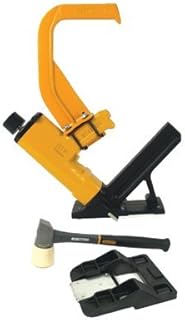
With only a product name on record and no specs or reviews, this listing offers too little information to recommend over a fully documented flooring nailer.
As an Amazon Associate I earn from qualifying purchases.
Metabo HPT, Powernail, Freeman, Spotnails, Cadex lead this category among the 6 brands that passed our curation checks.
A listing appears only when it has a recorded price, a minimum customer rating, and enough ratings or monthly sales. Generic and unbranded listings are left out, while every real brand stays, including brands sold only on Amazon. The ones that pass are ordered by the ProductDome score, which weighs owner satisfaction, rating volume, demand and data quality.
Flooring nailers drive cleats or staples at an angle through the tongue of hardwood flooring boards into the subfloor, hiding the fastener under the next board. Most are pneumatic tools struck with a mallet, while some are manual nailers that need more force but no compressor. The first decision is the fastener type, because cleat nailers and staplers hold differently and some flooring makers specify one or the other in their warranty.
Board thickness and adapters are the next question. Each nailer handles a range of flooring thicknesses, and interchangeable base plates adapt it to thinner boards. Using the wrong plate can damage the tongue or set the fastener at the wrong depth. Check the board thickness of your flooring before choosing a tool.
Mallet and compressor matter in daily use. A pneumatic nailer needs a compressor that delivers enough air at the working pressure, and a good rubber mallet that sits comfortably in your hand. Some nailers are sold as kits with a mallet, plates and a case.
Before buying, check the fastener type and sizes, the board thickness range, the included plates, the air requirement and whether a mallet comes with it. Rent a nailer for a single room project if you will not use it again, and check the flooring manufacturer's instructions for fastener spacing and type. Wear knee pads and eye protection, and keep a hand nailer or a brad nailer for the first and last rows, where the main nailer does not fit.
How we list products: every listing here has a recorded price, a minimum customer rating and enough ratings or monthly sales. Generic and unbranded listings are left out; every real brand stays, including brands sold only on Amazon. Products are ordered by the same ProductDome score on every page.Editorial policy