
Stationary Air Compressors
Ingersoll Rand SS3L3 Single-Stage Air Compressor 60 Gallon
- Tank Volume
- 60 gallons
- Capacity
- 60 gallons
- Air Flow Capacity
- 11.3 m3/min
- Maximum Pressure
- 135 psi
 USUnited States
As an Amazon Associate I earn from qualifying purchases. ProductDome earns a commission when you buy through links on this page.


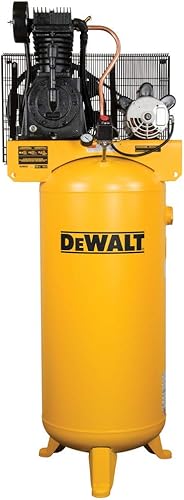
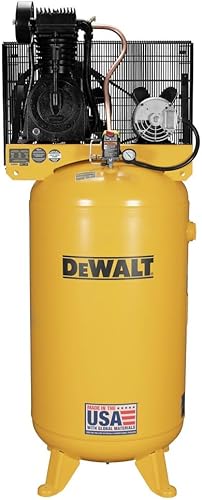

A usable oil-free option once the 220V/60Hz wiring and roughly 15 SCFM output are confirmed to match the shop's tools and power.
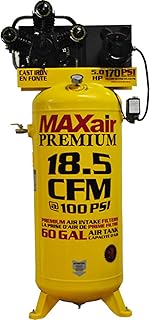
A 60-gallon stationary compressor with a 170 PSI ceiling for shop air, though buyers needing exact CFM or motor specs should confirm them first since this listing omits them.

The two-stage, pressure-lubricated pump is the right mechanism for sustained shop use, but the 3.8 average asks for a closer look at recent feedback before ordering.

A compact corded Craftsman compressor with a 0.5 gallon tank, suited to quick inflation and light pneumatic tasks rather than sustained tool use.

A straightforward single-stage 80 gallon compressor for garage-level tool use; the 4.6 rating is encouraging but rests on a thin 10-review sample.

The two-stage pump and known compressor line are real positives, but a 3.1 average from only 10 reviews is a caution flag that outweighs brand recognition here.

The ASME-stamped tank and 175 PSI ceiling make this a solid mid-size shop compressor, with a 4.3 average from 10 reviews as a reasonable, if early, signal.

The 19 CFM output and isolator pads make this a capable two-stage option, but the 5.0 rating needs more than 9 reviews before it can be trusted fully.
As an Amazon Associate I earn from qualifying purchases.
Ingersoll Rand, DeWalt, Ingersoll-Rand, Industrial, Craftsman lead this category among the 11 brands that passed our curation checks.
A listing appears only when it has a recorded price, a minimum customer rating, and enough ratings or monthly sales. Generic and unbranded listings are left out, while every real brand stays, including brands sold only on Amazon. The ones that pass are ordered by the ProductDome score, which weighs owner satisfaction, rating volume, demand and data quality.
Stationary air compressors are large, tank mounted machines for garages and workshops that run air tools, spray guns and blasting cabinets for long periods. They differ from portable compressors on the next page, which are made to be carried to a job. The first decision is the air demand of the tools you will run, because a compressor that cannot keep up forces you to stop and wait for the tank to refill.
Air delivery is the number that matters most. Every air tool lists the volume of air it needs at a stated pressure, and continuous tools such as sanders, grinders and spray guns need far more than nailers or tyre inflators. Compare the compressor's air flow rating at the pressure your tools use, and leave a margin. Among the 14 products that list tank volume, most fall between 60 and 80 gallons, and 70 gallons is typical. A larger tank evens out demand and lets the motor rest between cycles, but it does not raise the air flow the pump can deliver.
Power supply and installation are the next questions. Most stationary compressors run on a dedicated higher voltage circuit and need correct wiring, and some need a specific plug or hard wiring by an electrician. Vertical tanks take less floor space, and two stage pumps are made for heavier, longer use. Noise is significant, so many owners place the compressor in a separate room or shed and run air lines to the work area.
Before buying, check the voltage and amperage, the air flow at the working pressure, the duty cycle, the pump type and whether it is oil lubricated, and the dimensions including height. Plan for a pressure regulator, a filter and a water separator, drain the tank regularly, and check that the floor can take its weight.
How we list products: every listing here has a recorded price, a minimum customer rating and enough ratings or monthly sales. Generic and unbranded listings are left out; every real brand stays, including brands sold only on Amazon. Products are ordered by the same ProductDome score on every page.Editorial policy