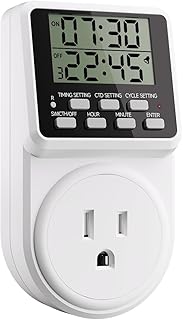
Outlet timers plug into a wall socket and switch a lamp, appliance or fan on and off on a schedule. They come as mechanical dial timers with pins, digital timers with a small screen and buttons, and smart plugs controlled by an app or voice assistant. The first decision is how often your schedule changes, because a mechanical timer is easy to set once but tedious to reprogram, while digital and smart timers handle different times on different days.
Mechanical timers are cheap and simple, but they lose time after a power cut unless they have a backup battery, and the number of settings describes how finely the day is divided. Digital timers store several programs, random modes that make an empty house look occupied, and countdowns. Among the 5 products that list screen size, most fall between 1.4 and 4.3 inches, and 2 inches is typical. A larger display is easier to read and set, especially for older users. Smart plugs need a home network and an app, and some only work with particular voice assistants.
Load and fit matter more than features. Check the maximum load in amps or watts against what you plug in, since heaters and air conditioners draw a lot of current. Bulky timers can block the second socket in a duplex outlet, so look at the shape and the position of the plug.
Before buying, check whether the timer is for indoor use only, the number of outlets it controls, whether a single unit or a pack is listed, and whether it keeps settings during a power cut. Never plug a timer into an extension lead that is already near its limit. For aquariums and grow lights, look at whether the shortest on and off interval suits the schedule your plants or fish need.
How we list products: every listing here has a recorded price, a minimum customer rating and enough ratings or monthly sales. Generic and unbranded listings are left out; every real brand stays, including brands sold only on Amazon. Products are ordered by the same ProductDome score on every page.Editorial policy

 Best Overall