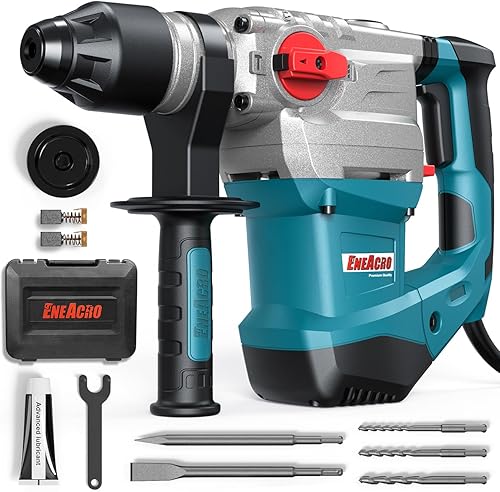
Rotary hammers drill and chisel into concrete, block and stone with a powerful hammer mechanism, and they hit much harder than a hammer drill. They are the tool for anchors in concrete, holes for pipes and cables, and light demolition such as removing tile or chipping concrete. The first decision is the size of holes you drill most, because compact rotary hammers suit anchors and small holes, while larger models handle big holes and chiselling.
The bit system is the next question. Most compact rotary hammers use one bit shank system, and larger models use a heavier system; the bits are not interchangeable, so match the hammer to bits you can buy easily. A three mode tool drills, hammer drills and chisels, and a rotation stop is needed for chiselling.
Vibration control and ergonomics matter on long jobs. Look for anti vibration handles, a depth rod for repeatable hole depth, and a clutch that stops the tool twisting if the bit jams. Cordless rotary hammers are now common and convenient, while corded models suit long demolition work.
Before buying, check the bit system, the impact energy stated by the maker, the modes, the weight, and whether a case, side handle and depth rod are included. Use dust extraction or a dust attachment, wear eye, hearing and breathing protection, and scan for rebar, pipes and cables before drilling.
How we list products: every listing here has a recorded price, a minimum customer rating and enough ratings or monthly sales. Generic and unbranded listings are left out; every real brand stays, including brands sold only on Amazon. Products are ordered by monthly searches for their brand and model on every page.Editorial policy


 Best Overall